
AI assistants are the new storefront. Is your catalog ready?
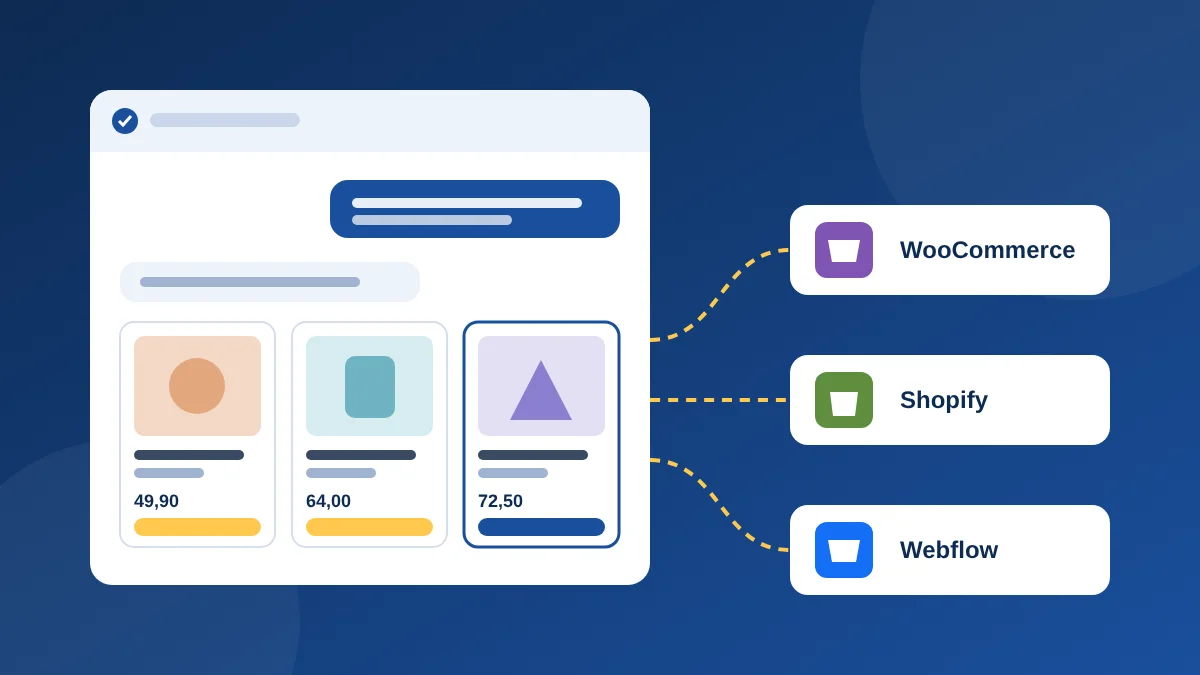
Agentic commerce is shopping that AI assistants such as ChatGPT, Gemini and Copilot research, and sometimes complete, on a customer's behalf. To benefit from it, a WooCommerce, Shopify or Webflow store mainly needs clean, complete and current product data: product feeds, structured data, prices, stock, shipping and return policies. In late 2026, AI is mostly where people discover and compare products; the purchase still happens on your site.
The shopper who used to type "best sunscreen for sensitive skin" into Google now asks a chat assistant the same question. The answer comes back with three products, their prices, their ratings and a link to each store. If AI agents cannot read your catalog, you are simply not in that shortlist.
This guide is for online store owners, marketing teams and startups who want a clear view of where agentic commerce actually stands, which protocols matter, and what to change on their platform first.
What is agentic commerce?
An "agent" is an AI assistant that can act for a user: search for products, compare offers, check availability and even place an order. In practice, agentic commerce covers two very different things:
- AI-assisted discovery: the assistant recommends products and sends the shopper to the store's product page. This is how most AI shopping works today.
- Delegated checkout: the shopper confirms the purchase inside the conversation and the agent passes the order and payment to the merchant.
The distinction matters when you decide where to invest. According to Adobe Analytics, traffic from generative AI to US retail sites grew 693.4% year over year during the 2025 holiday season. That traffic lands on stores, which makes AI shopping first and foremost a visibility and conversion challenge on your own site.
Where does agentic commerce stand in late 2026?
A lot has changed in twelve months. These are the milestones worth knowing:
| Date | What happened | Why it matters |
|---|---|---|
| September 2025 | OpenAI launches Instant Checkout and the Agentic Commerce Protocol (ACP) with Stripe | First purchases inside ChatGPT, starting with US Etsy sellers |
| January 11, 2026 | Google announces the Universal Commerce Protocol (UCP), co-developed with Shopify, Etsy, Wayfair, Target and Walmart | An open standard for discovery, checkout and post-purchase in AI Mode and Gemini |
| March 2026 | OpenAI refocuses Instant Checkout on a discovery-first model | Purchases mostly complete in merchant apps or on the merchant's site |
| March 24, 2026 | Shopify launches Agentic Storefronts | Shopify merchants' products become discoverable in ChatGPT by default and can be syndicated to Copilot, AI Mode and Gemini |
| 2026 | WooCommerce publishes its agentic roadmap (MCP in beta, UCP and ACP announced) | WordPress stores rely on Google Merchant Center and structured data for now |
OpenAI's retreat from in-chat checkout says a lot. Forrester, as reported by Digital Applied, counted only about 30 Shopify merchants live on Instant Checkout in February 2026. The takeaway for merchants: the goal is not to sell inside the chat, it is to get recommended by it.
ACP, UCP and MCP: the three protocols to know
You will rarely implement these yourself, but knowing what each one does helps you understand what your platform offers.
| Protocol | Backed by | What it does | Where it shows up |
|---|---|---|---|
| ACP (Agentic Commerce Protocol) | OpenAI and Stripe | Connects a merchant catalog to an AI agent and, where enabled, passes on the order | ChatGPT |
| UCP (Universal Commerce Protocol) | Google and Shopify, with 20+ partners | Open standard covering discovery, cart, payment and post-purchase | AI Mode in Google Search, Gemini |
| MCP (Model Context Protocol) | Anthropic, widely adopted | Gives an AI assistant secure access to live data in a tool: products, stock, orders | Any compatible assistant |
All three run on the same fuel: structured product data. A vague title, a missing price or wrong stock, and the agent either skips the product or describes it badly.
What each platform supports today
Shopify: furthest ahead
Shopify has a clear head start. Its March 2026 announcement explains that Agentic Storefronts make merchants' products discoverable in ChatGPT by default through Shopify Catalog, with other AI channels managed from the Shopify admin. Shopify also offers an "Agentic plan" so brands that do not run on Shopify can add their products to the same catalog.
On Shopify, then, the work is not the technical connection but data quality: descriptive titles, useful descriptions, clean variants, completed category metafields and GTINs where they exist.
WooCommerce: solid foundations, connectors on the way
WooCommerce's agentic commerce page lists MCP support in beta (WooCommerce 10.9 and WordPress 6.9 or later, through the Abilities API), while UCP and ACP are marked "coming soon", including through the Stripe extension. In the meantime, WooCommerce points merchants to Google for WooCommerce to sync their catalog with Merchant Center.
For a WooCommerce store, the smart move is to perfect your Google Merchant Center product feed and your Product structured data now. That is exactly the data future connectors will reuse.
Webflow: go through feeds
As far as we know, Webflow has not announced a native agentic connector comparable to Shopify's. A Webflow store can still be visible by publishing a product feed to Google Merchant Center, exposing complete structured data and, for ChatGPT, applying to OpenAI's merchant program. Brands that want to go further can look at Shopify's Agentic plan.
7 things to fix so AI agents recommend your products
- A complete product feed. OpenAI's product feed specification requires at least an ID, title, description, URL, brand, seller name, image, availability and price. A missing or unrecognized availability value gets the row rejected. OpenAI recommends a full refresh at least once a day.
- Reliable identifiers. Add the GTIN where one exists, otherwise brand plus manufacturer part number. Never make up a GTIN.
- Clear policies. Shipping cost, delivery time, whether returns are accepted and the return window all exist as feed fields and influence comparisons. Our ecommerce shipping strategy guide covers how to present them.
- Descriptions that answer questions. Agents compare. State who the product is for, its dimensions, materials, limits and what sets it apart from the alternative. Empty marketing copy gives an agent nothing to compare.
- Genuine customer reviews. Review count and average rating are recommended fields. See our guide to ecommerce product reviews.
- A site AI crawlers can reach. Check your robots.txt. OpenAI, for example, separates its search crawler (OAI-SearchBot) from its training crawler (GPTBot), as its crawler documentation explains. Blocking the first removes you from ChatGPT search answers.
- Dedicated measurement. Separate traffic from chatgpt.com, gemini.google.com, copilot.microsoft.com and perplexity.ai in GA4. Our GA4 ecommerce tracking guide shows how to build a custom channel group.
Example: a WooCommerce skincare brand selling into Europe
Take an illustrative case: a Tunisian natural skincare brand sells locally and ships to France and Germany. The team asks ChatGPT for "organic prickly pear seed oil for the face, shipped to Europe". The brand does not appear, while two European competitors do.
The audit finds titles that are too short ("Precious Oil 30 ml"), no mention of the organic certification in the description, no GTINs, a return policy buried in the terms and conditions, and half of the Merchant Center feed rejected because of price mismatches. A typical action plan:
- rewrite titles using "product type + key ingredient + benefit + size";
- add a "who it's for, how to use it, what it won't do" section to each product page;
- fix the feed and add shipping, returns and reviews;
- complete the Product markup with offer, brand and aggregate rating;
- track AI traffic monthly and rerun the same test prompt.
Keep expectations realistic: agentic checkout features are still concentrated in the US, and cash on delivery has no equivalent in these protocols. Discovery, on the other hand, works wherever people use AI assistants.
Agentic commerce checklist
- Catalog synced to Google Merchant Center with no blocking errors.
- Descriptive titles, factual descriptions, complete attributes and variants.
- GTIN or manufacturer part number for every product that has one.
- Prices and stock refreshed at least daily in every feed.
- Shipping and return policy in the feed and visible on the product page.
- Validated Product and review structured data, with no duplicates.
- robots.txt that allows AI assistants' search crawlers.
- An "AI assistants" channel set up in GA4.
- Monthly test: ask ChatGPT, Gemini and Copilot about your best sellers the way a shopper would.
Conclusion: better product data means more sales
Agentic commerce does not require rebuilding your store. It rewards stores that already have clean foundations: a well-structured catalog, solid technical SEO and clear shipping and returns information. The protocols will keep changing, but those foundations stay valuable whichever platform wins.
Our team works with brands in Tunisia and Europe on WooCommerce, Shopify and Webflow: product feeds, structured data, ecommerce SEO and online store development. Explore our WooCommerce development services, or send us your store URL for an AI visibility audit.